Today Sri Lanka is bracing for what meteorologists are calling one of the strongest El Niño events in decades — and for an island nation whose economy, food security, and energy supply are all tightly bound to the rhythm of its monsoons, that is not a small thing.
What’s Happening in the Pacific
El Niño is the warm phase of the El Niño–Southern Oscillation (ENSO), a natural climate cycle driven by shifting sea-surface temperatures in the central and eastern equatorial Pacific. After a weak La Niña faded into neutral conditions earlier in the year, El Niño officially developed around mid-2026 and has been strengthening quickly since. By August 2026, forecasters at NOAA and the World Meteorological Organization were placing the odds of a very strong — even potentially record-strength — El Niño for the 2026–27 northern hemisphere fall and winter at over 90%. Sri Lanka’s own Department of Meteorology has echoed this, warning of roughly a 69% chance that the developing event could turn out stronger than anything experienced in the past 75 years.
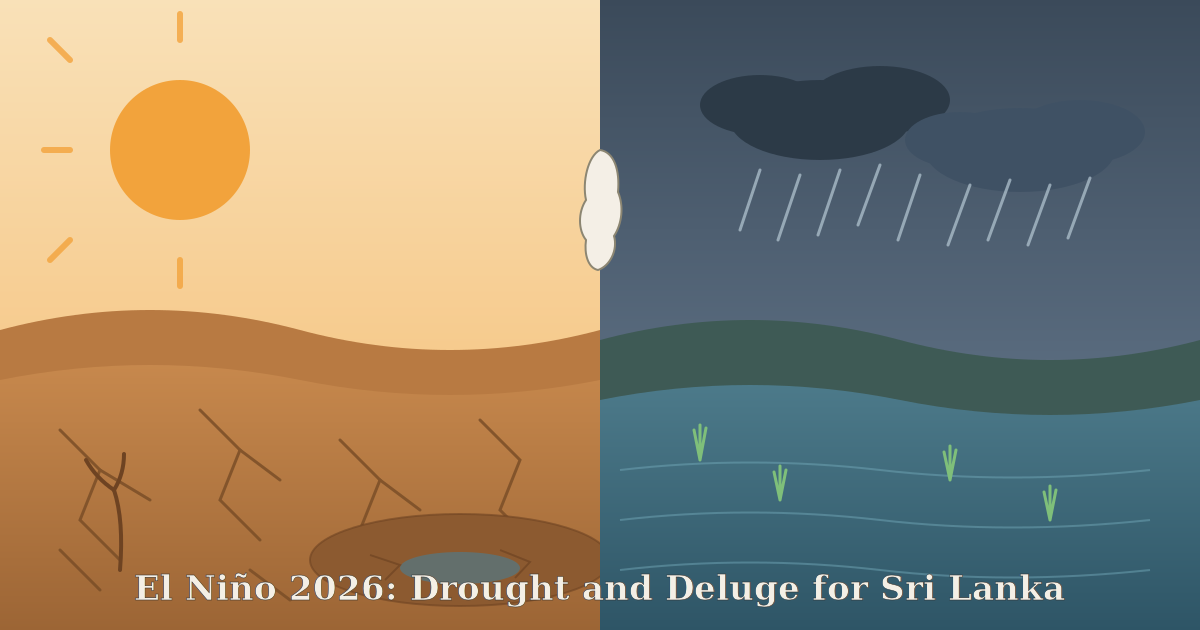
El Niño itself doesn’t directly cause Sri Lanka’s weather, but it reshapes the larger atmospheric patterns — the monsoon winds, the Indian Ocean Dipole (IOD), and Bay of Bengal storm activity — that do. That makes 2026 a year of unusual climate whiplash for the island: drought in one season, and the risk of heavy rain and flooding in the next.
A Dry First Half of the Year Through much of 2026, the dominant story has been dryness. Hot, low-rainfall conditions intensified across large parts of the country as the Southwest Monsoon underperformed, and by mid-year several reservoirs and irrigation tanks — vital for both farming and hydropower — had begun visibly drawing down. Areas of the Northern, North Central, and Eastern Provinces, along with parts of Uva, saw below-normal rainfall, raising concern for the ongoing Yala cultivation season, which depends heavily on Southwest Monsoon rain and irrigation.
This pattern is consistent with how El Niño has historically behaved in Sri Lanka: warmer temperatures, a weaker Southwest Monsoon, accelerated soil-moisture loss, and mounting stress on reservoirs used for both drinking water and electricity generation. Even so, officials note that reservoir levels going into the second half of the year were around 56% of capacity — comparable to previous years, but with much less room to absorb a prolonged shortfall if dry conditions persist into 2027.
The Turn: Heavy Rain Expected Late 2026 The second half of the story looks very different. Sri Lankan officials, including Environment Minister Dhammika Patabendi, have warned that the current dry spell is expected to give way to heavy rains from late September through December 2026, driven by the Second Inter-Monsoon and a Northeast Monsoon onset complicated by El Niño’s influence. Intense rainfall in this window raises the risk of flash floods and landslides, particularly in the central hill country — a real concern given the scale of destruction the island suffered from Cyclone Ditwah, which claimed nearly 650 lives and caused an estimated US$4.1 billion in damage.
Adding another layer of complexity is the Indian Ocean Dipole. Forecasts suggest roughly a 60% chance that a positive IOD will develop later in 2026. A positive IOD tends to warm the western Indian Ocean and encourage cloud formation closer to Sri Lanka, which could boost rainfall during the Second Inter-Monsoon and partially offset drought risk — but only if it develops early and strongly enough to counteract El Niño’s drying influence. Meteorologists say the August–September period should make this picture much clearer.
Then comes the pivot back the other way: current outlooks suggest that once these rains pass, Sri Lanka could face a renewed and possibly prolonged drought in early-to-mid 2027, as the El Niño event lingers into its later stages.
Why This Matters Beyond the Weather
El Niño is best understood not as a single disaster but as a “risk multiplier” — it amplifies vulnerabilities that already exist across Sri Lanka’s economy:
• Agriculture and food security: Reduced or delayed rainfall during the Yala season threatens yields for rice and other staple crops. Lower yields typically mean higher production costs for farmers, potential food shortages, greater reliance on imports, and upward pressure on food prices — all significant concerns for a country still recovering from its 2022 economic crisis.
- Water and hydropower: Sri Lanka relies heavily on reservoirs for both irrigation and electricity. Prolonged dry spells strain water availability for households, farms, and power stations simultaneously, increasing the odds of water rationing or a greater reliance on costlier thermal power generation.
- Flood and landslide risk: The anticipated shift to heavy rainfall later in the year raises the danger of flash floods and landslides in mountainous and low-lying regions alike, particularly where soils are already destabilized from earlier extreme weather events.
- Public health and labor: Higher temperatures and heatwave risk associated with El Niño can affect health outcomes and outdoor labor productivity, particularly in agriculture and construction.
- Economic planning: With the country still stabilizing after its debt crisis, an erratic, high-variability climate year makes fiscal and agricultural planning considerably harder for policymakers. How Sri Lanka Is Preparing
In response, the government has set up a ministerial panel to coordinate the country’s response to the anticipated “worst” El Niño on record, according to Minister Patabendi. The Department of Meteorology is closely tracking how El Niño, the IOD, and the Madden-Julian Oscillation interact in the coming weeks, since their combined behavior — not El Niño alone — will determine whether the country tips more toward drought or flood in any given region. Farmers and irrigation officials are also being urged to plan for both possibilities: preparing for potentially drier-than-normal conditions in some areas while remaining alert to sudden, intense rainfall events elsewhere.
The Bottom Line
For Sri Lanka, 2026 is shaping up to be a year defined less by a single climate extreme and more by volatility — dry conditions and heat stress giving way to a risk of intense rain, floods, and landslides before the cycle potentially swings back to drought in 2027. Whether the worst-case scenarios materialize will depend heavily on how the Indian Ocean Dipole and monsoon dynamics play out over the coming months. What is already clear, though, is that the stakes — for farmers, reservoir managers, power planners, and communities in flood-prone regions — are high, and that preparedness now is far cheaper than recovery later.
This article reflects meteorological forecasts and official statements available as of late August 2026. ENSO forecasts are updated monthly and may change as the event evolves.